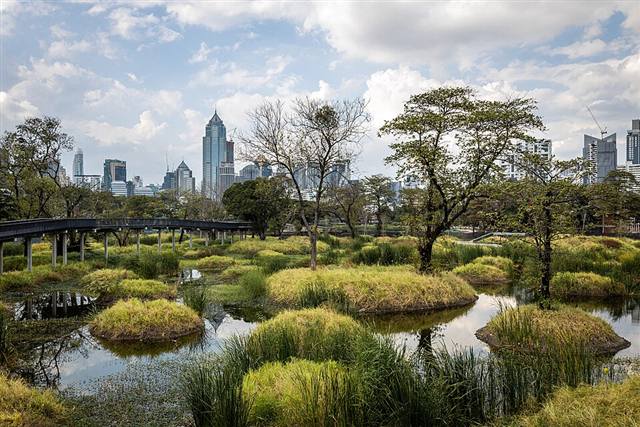
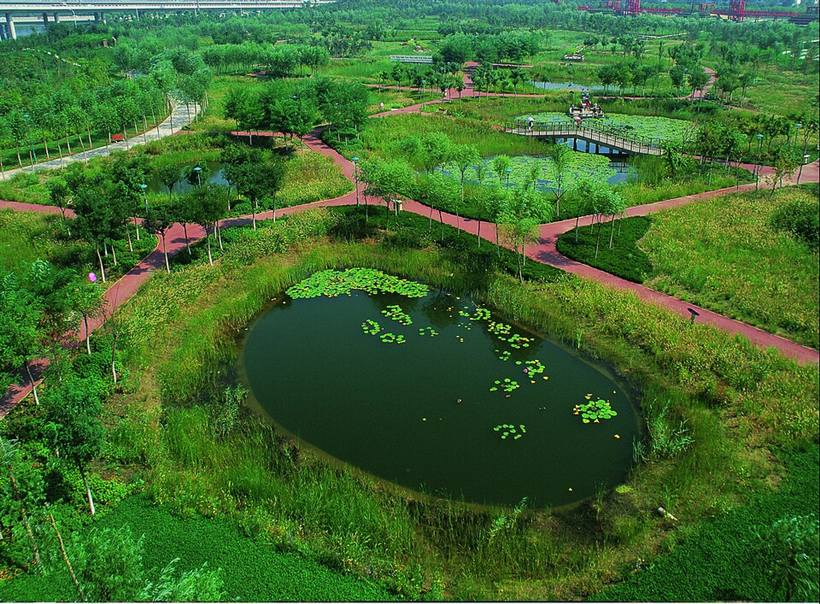
A sponge city handles rain where it falls. Instead of piping stormwater away as fast as possible, it soaks up, holds, cleans and reuses it, using soil, plants, wetlands and permeable surfaces.
The idea became national policy in China after the Beijing flood of July 21, 2012, which killed 79 people. Xi Jinping spoke about it at the Central Urbanization Work Conference in December 2013, the housing ministry issued technical guidelines in October 2014, and a State Council guideline in October 2015 set the targets: urban areas should absorb or reuse 70% of the rain that falls on them, on more than 20% of built-up land by 2020 and more than 80% by 2030. The target applies to land area, not to 80% of cities.
China named 16 pilot cities in 2015, among them Wuhan, Chongqing, Xiamen and Jinan, and 14 more in 2016, including Beijing, Tianjin, Shanghai and Shenzhen. The first 16 spent about $12.2 billion over three years on about 450 sq km, or $14 million to $21 million per sq km. Central subsidies ran at $57 million to $85 million a year per pilot, depending on the city's status, and public-private partnerships were expected to cover much of the rest. Meeting the 2030 target has been estimated to cost about $230 billion.
The landscape architect most closely linked with the idea, Kongjian Yu, founded the design firm Turenscape in 1998 and won the Cornelia Hahn Oberlander International Landscape Architecture Prize in 2023. He died in a plane crash in Brazil in September 2025.
Evidence of results is growing but uneven. A Nature Cities study published in September found that cities in the programme cut flood-related dysentery risk by up to 12.2% by the third year. Against that, 19 of the 30 pilot cities flooded after 2014, and the government has published little monitoring data, while some projects have used the "sponge" label for ornamental work. Sponge measures are designed for frequent storms, not extreme ones. In Zhengzhou on July 20, 2021, 201.9 mm of rain fell in a single hour; the State Council investigation put the Henan toll at 398 dead or missing, 380 of them in Zhengzhou.
Other cities use the same tools under different names. Copenhagen's Cloudburst Management Plan designs streets and parks to carry water to the harbour. Rotterdam's Benthemplein water square, opened in December 2013, has two shallow basins that fill with every shower and a deeper one that fills only in prolonged rain. Berlin's Rainwater Agency, set up by the city and its water utility, advises owners on green roofs, de-sealing and infiltration under the "Schwammstadt" banner.
Sources: Griffiths et al., Phil. Trans. R. Soc. A, 2020 - Sponge city (reference) - Kongjian Yu (reference) - Nature Cities - 2021 Henan floods (reference) - De Urbanisten - Berliner Regenwasseragentur